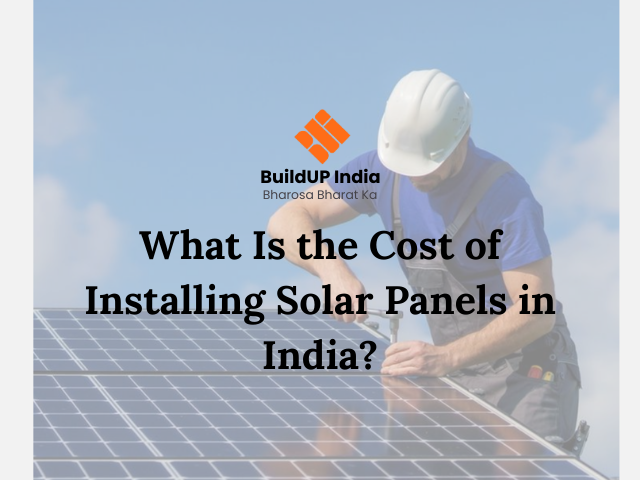
What Is the Cost of Installing Solar Panels in India?
What Is the Cost of Installing Solar Panels in India?

Category
Solar Panel
Date Released
03 March, 2026
Many people want to install solar panels at home to reduce electricity bills. But before making a decision, the first question is:
👉 What is the total cost of installing solar panels in India?
Let’s understand everything in very simple words.
Average Cost Per kW in India (2026)
In India, solar installation cost is usually calculated per kilowatt (kW).
Here is the average price range:
1 kW system → ₹45,000 to ₹70,000
2 kW system → ₹90,000 to ₹1,40,000
3 kW system → ₹1,35,000 to ₹2,10,000
5 kW system → ₹2,25,000 to ₹3,50,000
10 kW system → ₹4,50,000 to ₹7,00,000
This cost usually includes:
Solar panels
Solar inverter
Mounting structure
DC and AC wiring
Installation charges
Net meter (for on-grid systems)
The final cost depends on system size and quality.
What Type of Solar System Affects the Cost?
There are three main types of solar systems in India.
1. On-Grid Solar System
This system is connected to government electricity.
No battery needed
Lower installation cost
Best for reducing electricity bills
Average cost: ₹45,000–₹60,000 per kW
This is the most affordable option.
2. Off-Grid Solar System
This system uses batteries.
Works without electricity connection
Good for villages or remote areas
More expensive due to batteries
Average cost: ₹70,000–₹1,00,000 per kW
3. Hybrid Solar System
This is a mix of on-grid and off-grid.
Connected to grid
Has battery backup
Works during power cuts
Average cost: ₹85,000–₹1,20,000 per kW
This is the most expensive option.
What Affects the Installation Cost?
Many small factors can change the total price.
1. System Size
Bigger system = Higher total cost
But per kW price may become slightly lower for bigger systems.
2. Quality of Solar Panels
Mono PERC panels → Higher efficiency, slightly costly
Polycrystalline panels → Lower price
Better panels may cost more but produce more electricity.
3. Inverter Quality
A good inverter improves performance and lasts longer.
Higher quality inverter increases total cost.
4. Roof Type
Flat concrete roof → Easy installation
Metal or tilted roof → May increase cost
If your roof has shadow, extra structure may be needed.
5. Location
Installation charges may vary from city to city.
Labor cost is different in metro cities and small towns.
Government Subsidy in 2026
The government gives subsidy for residential rooftop solar systems.
Subsidy structure:
₹30,000 per kW for first 2 kW
₹18,000 per kW for additional 1 kW
Maximum around ₹78,000 for 3 kW system
Example:
If 3 kW system costs ₹1,80,000
Subsidy = ₹78,000
Final amount you pay = Around ₹1,02,000
This reduces your total installation cost a lot.
Is Solar Installation Expensive?
At first, the cost may look high.
But solar panels last 20–25 years.
Most people recover their investment in 4–6 years.
After that, electricity is almost free.
If your monthly bill is ₹3,000:
Yearly saving = ₹36,000
In 5 years = ₹1,80,000 saved
So in long term, solar is a smart investment.
Final Answer
So, what is the cost of installing solar panels in India?
👉 On average, it costs between ₹45,000 to ₹1,20,000 per kW, depending on system type and quality.
The total amount depends on:
System size
Type (On-grid, Off-grid, Hybrid)
Panel and inverter quality
Roof condition
Government subsidy
With subsidy and long-term savings, solar installation becomes affordable and beneficial for homeowners.
FAQs
1. What is the cost of 1 kW solar system in India?
It costs around ₹45,000 to ₹70,000.
2. How much does a 5 kW solar system cost?
It usually costs between ₹2.2 lakh to ₹3.5 lakh.
3. Is government subsidy available in 2026?
Yes, subsidy is available for residential rooftop systems.
4. Does installation cost include inverter and wiring?
Yes, most quoted prices include inverter, structure, and wiring.
5. How long does solar installation take?
Usually 2–5 days for residential systems.
6. Can I install solar panels without subsidy?
Yes, but subsidy reduces the total cost.
7. Is solar installation worth the cost?
Yes, because long-term savings are much higher than the initial investment.